Despising the Small: How American Christianity Learned to Distrust Faithfulness Without an Audience

There is a word theologians sometimes use — particularity — to describe the audacious claim at the heart of Christian faith: that the eternal God entered history not as an abstraction, but as a specific person, born in a specific town, to a specific family, in a specific and rather unremarkable corner of the ancient world. The scandal was not merely theological. It was geographic. It was local. It was, by any reasonable accounting, obscure.
Patna knows something about obscurity. The capital of Bihar sits at a curious intersection — ancient enough to carry centuries of spiritual memory, populous enough to constitute a major Indian city, and yet consistently overlooked by the global conversation about Christianity's present and future. When Western Christians think about the vitality of faith in the Global South, their eyes tend to move toward Lagos or São Paulo or Seoul. Patna rarely appears on those maps. And that, we would argue, is precisely why it deserves our most serious attention.
The Metrics We Worship Without Realizing It
American evangelical culture in particular has spent the better part of four decades developing a sophisticated vocabulary for spiritual success. Attendance figures. Giving trends. Sermon download counts. Social media engagement. Campus expansions. The language is borrowed almost wholesale from the corporate sector, and it carries with it an implicit theological claim: that God's blessing is most legibly expressed through growth, and that growth is most honestly measured by scale.
This is not a fringe position. It is the ambient assumption of most American church culture, absorbed not through formal teaching but through the steady accumulation of which stories get told, which leaders get platformed, and which congregations receive the admiring feature profiles in Christian publications. A church of forty families that has served its neighborhood faithfully for sixty years rarely makes the cover of anything. A church that launched three years ago and now fills a renovated warehouse with two thousand weekly attenders will find speaking invitations arriving before the paint is dry.
We have, in other words, learned to despise the small. We have dressed this contempt in the language of vision and impact, but the underlying disposition is not difficult to name: we are suspicious of any form of faithfulness that cannot be easily quantified or conveniently publicized.
What Patna's Parishes Actually Look Like
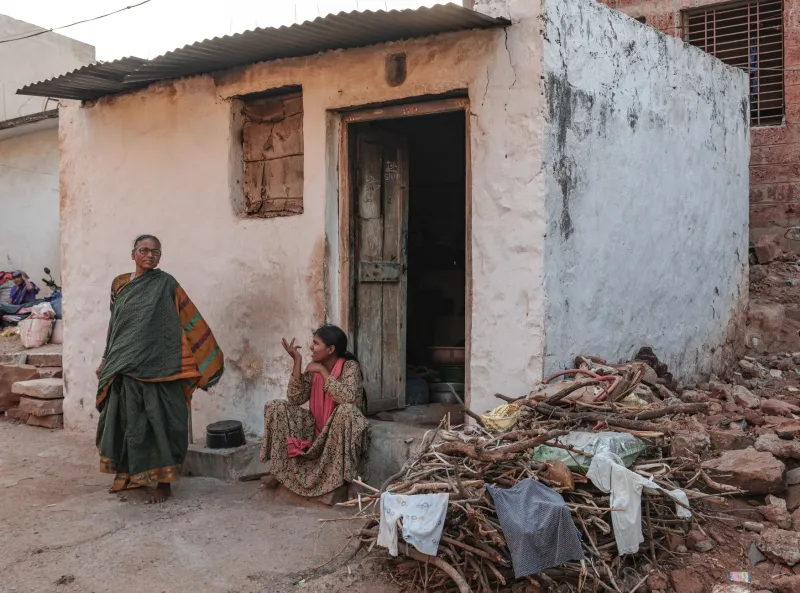
The Christian communities associated with institutions like Jesus and Mary in Patna do not, for the most part, look like anything a Western church-growth consultant would find encouraging. They are embedded in neighborhoods. They are intergenerational in ways that American congregations, with their age-segmented programming, have largely abandoned. Their ministry tends to be quiet — a student tutored through a difficult examination, a family accompanied through illness, a dispute mediated between neighbors who would otherwise have stopped speaking.
None of this produces content. Very little of it is photographable in any way that communicates drama or transformation at a glance. The work is, by almost every standard the American church has adopted, unglamorous to the point of invisibility.
And yet it persists. It has persisted through political upheaval, through economic hardship, through the departure of young people to larger cities, through the particular pressures that attend minority religious communities in a majority-Hindu context. The communities here have not survived because they mastered a growth strategy. They have survived because their faith was never primarily organized around growth in the first place. It was organized around fidelity — to place, to people, to practice, to one another.
The Theological Error Underneath the Preference for Scale
It is worth being precise about what has gone wrong, because the problem is not simply cultural vanity. There is a theological distortion operating beneath the surface of American Christianity's love affair with the spectacular.
When we evaluate spiritual communities primarily by their capacity to expand, we are — however unintentionally — suggesting that God's presence is more fully realized in large gatherings than in small ones, in viral moments than in quiet ones, in cities with recognizable names than in places most Americans could not locate on a map. We are, in effect, reversing the logic of the Incarnation. We are arguing, in practice if not in confession, that God prefers the impressive.
The testimony of Scripture runs in almost exactly the opposite direction. The prophets were consistently sent to the margins. The early church grew in the catacombs before it filled the basilicas. The mystics who shaped Christian contemplative tradition — many of them working in conditions of considerable material poverty and social irrelevance — produced spiritual fruit that outlasted empires. Bethlehem was not chosen because it was a prominent address.
Patna's Christian communities, in their quiet persistence, are not failing to achieve what the American church has achieved. They are, in many respects, practicing something the American church has largely forgotten how to do: they are being faithful without requiring the validation of an audience.
What Repentance Might Actually Require
Repentance is a word American Christianity uses frequently and practices inconsistently. In this particular case, repentance would require something more demanding than a sermon series on humility or a social media post about the beauty of small churches. It would require a genuine, structural reckoning with the incentive systems that currently govern how American believers allocate attention, funding, admiration, and trust.
It would mean asking, seriously and without defensiveness, whether the communities we celebrate most loudly are the ones most faithfully embodying the Gospel — or whether they are simply the ones that have most successfully adopted the communication and growth strategies of the broader consumer culture.
It would mean learning to sit with the discomfort of a community like Patna's, which offers no easy narrative of explosive transformation, no before-and-after statistics, no charismatic founder with a podcast. What it offers instead is something rarer and, we would argue, more spiritually instructive: decades of unspectacular fidelity, the slow accumulation of trust, the unremarkable and irreplaceable work of being present to particular people in a particular place over a long period of time.
The Gift We Keep Refusing
The American church has access to a corrective it keeps declining to receive. Communities like those in Patna are not asking for admiration. They are not positioning themselves as models to be replicated or brands to be franchised. They are simply doing what Christian communities have always been called to do, in the place where they have been set, with the resources they actually have.
That ordinariness is not a deficiency to be overcome. It is, properly understood, a form of theological integrity — a lived refusal to subordinate the Gospel to the logic of spectacle.
The scandal of particularity is that God keeps showing up in obscure places, among unimpressive people, doing work that does not scale. The deeper scandal is that we keep being surprised by this, and then quietly disappointed.
Patna is not waiting for our approval. But we would do well to consider what we might be waiting to receive from Patna — if we could only bring ourselves to pay attention to something that offers no immediate return on our investment of admiration.