What Your Church Prints About Itself When No One Is Reading
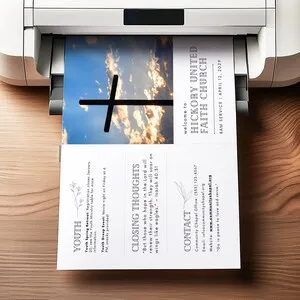
Photo: hand folded church bulletin single page paper pew, via i.etsystatic.com
There is a document that most American churchgoers have stopped actually reading. It arrives in their hands at the door, or appears in a QR code now, and it performs its function so smoothly that nobody asks what it is saying. We mean, of course, the bulletin.
In the parishes of Patna, the bulletin is a different animal entirely. It is one page. It is often photocopied in the parish office the morning of, sometimes folded by volunteers whose names never appear anywhere. There are no sponsors. There is no center-spread advertisement for the local Christian radio station. There is, typically, the order of the Mass, the intentions for the sick, the dates of the coming week, and a line or two from the pastor that reads less like marketing copy and more like a note from someone who knows you will see him at the door.
The contrast is instructive, but not for the reason sentimental observers usually assume. The point is not that paper is more authentic than pixels, or that modesty is a virtue in itself. The point is that a bulletin is a confession. It tells you what a community believes church is for.
The American Program as Mirror
Consider what the typical large American congregation's program contains. A welcome section written in the second person plural, addressed to guests who may not return. A branded logo treatment. Sponsor acknowledgments—often a full page—thanking the insurance agency, the orthodontist, the HVAC company. Three to five announcements for ministries competing for attention, each with its own tagline. A QR code, a website, an app download prompt.
None of this is sinister. Most of it is produced by overworked staff who genuinely love their church. But read it as a document from a foreign culture, the way an anthropologist would, and something emerges: this is the printed form of a congregation that understands itself as an organization with a customer base. The bulletin is a brochure. The reader is a prospect.
Now read Patna's single sheet the same way. The sick are named—individually, by name, including people no visitor has ever met. The week's schedule assumes you will be present for most of it. There is no pitch, because there is nothing to sell. The document presupposes belonging rather than soliciting it.
What Gets Omitted Matters More
Here is the diagnostic value: not what the bulletin contains, but what it assumes.
A bulletin that assumes you are a stranger will speak in the language of invitation. A bulletin that assumes you are family will speak in the language of obligation—and obligation, in the older and better sense of the word, is not a burden but a bond. The Patna sheet names who is cooking for the feast day, who is teaching the children this month, whose mother died and needs the community's prayers. It is a rota of mutual dependence.
The glossy American program, by contrast, rarely names anyone except staff and sponsors. Individuals appear as roles; the congregation appears as an aggregate. Dependence—the actual, daily kind—appears nowhere, because dependence is precisely what the modern American church has organized itself to eliminate.
A Test You Can Run This Sunday
We would suggest a simple exercise. Take your church's bulletin or program this weekend and ask five questions of it.
One: Are more than three laypeople named by name, in roles that involve ordinary service rather than platform performance? If not, the community may be structured around a stage rather than a body.
Two: Does the document assume you will be back next week? Look for the grammar of continuity—preparation for an event weeks away, follow-up from something past. A bulletin written only for the present moment is a bulletin written for visitors.
Three: Are the sick, the grieving, and the homebound named specifically? Intercessory lists are the closest thing American church print culture has to Patna's prayer sheets, and their absence is telling.
Four: Could a newcomer tell, from this document alone, what this church actually believes—confessionally, substantively—or only what it offers?
Five: Is there anything in it you would be embarrassed to show a Patna parishioner? The sponsor page usually fails this test, not because commerce is dirty, but because the pairing of the Eucharist with orthodontia quietly answers the question of what the community thinks the Eucharist is comparable to.
The Deeper Point
None of this means American churches should imitate Patna's formatting. Photocopies and hand-folding are products of circumstance, not holiness. The lesson is thinner and sharper: a community's printed ephemera is a running audit of its self-understanding, and most of us have never audited ours.
The churches of Patna did not decide to make their bulletins honest. They simply never had the resources to make them dishonest. That may be the most valuable constraint of all.