Five 'Inefficient' Classroom Habits That Built a Faith America's Curriculum Software Cannot Replicate
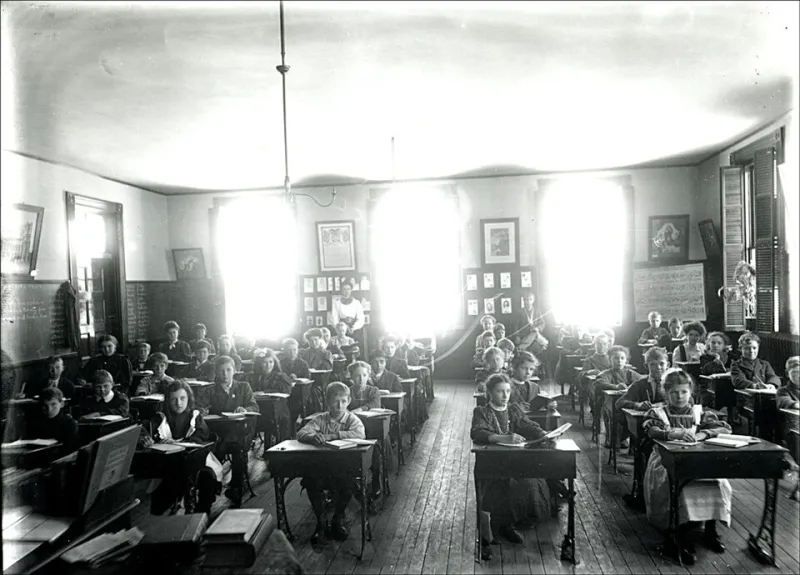
Photo: Keene and Cheshire County (NH) Historical Photos, No restrictions, via Wikimedia Commons
Somewhere in the last forty years, American Christian education made a wager: that if learning were sufficiently entertaining, it would also be lasting. The wager has been settled, and the results are in. Vast numbers of young Americans raised on video-based Sunday curricula, gamified Bible apps, and youth rooms with fog machines exit their teens with almost no doctrinal vocabulary and no habits of devotion. The entertainment was delivered. The formation was not.
The Catholic schools of Patna never made that wager, largely because they could not afford to. What they kept, out of constraint, turns out to be a catalogue of methods that educational theory abandoned and the outcomes suggest we should not have. Five of them deserve a closer look.
One: The Memorized Chorus
Patna's schoolchildren sing. Not perform—sing. Short refrains, often in Hindi or a regional language, repeated daily until the words live somewhere below conscious recall. American education long ago classified memorization as mere rote, and replaced it with comprehension-first pedagogy. But comprehension without memorization leaves the believer with nothing to say in the hospital corridor, nothing on the long commute, nothing at two in the morning. The chorus is not a substitute for understanding. It is what understanding gets to keep.
Two: Shared Chores
In Patna's schools, students sweep. They ring the bell, water the plants, distribute the midday meal. American Christian education outsourced this to facilities staff long ago, partly for liability, partly because chores read as drudgery rather than pedagogy. But the theology embedded in a broom is difficult to replicate in a lesson plan: the house of God is maintained by its members, and no one's contribution is beneath anyone. Children who swept the classroom do not grow into adults who regard service as a volunteer option they might decline.
Three: Copying by Hand
American classrooms moved past handwriting decades ago; Patna's students still copy passages—scripture, catechism, hymn texts—line by line into notebooks. The practice looks archaic. It is not. Copying forces a pace slow enough for the text to become one's own; the hand cannot skim. Every study of retention that has emerged since confirms what the old method knew implicitly: production beats recognition, and the slowness is the mechanism. A generation that has never copied a verse by hand has never actually dwelt in one.
Four: Recitation in Unison
There is something deeply unfashionable about thirty children speaking the same words at the same moment. It strikes the modern ear as regimented, even coercive. But unison recitation does something individualized learning cannot: it teaches a child that his voice is part of a voice, that the faith he is learning is not a private possession but a shared inheritance spoken by others before him and alongside him. The American instinct toward personalized faith formation has produced, predictably, personalized faith—brittle, individual, and easily dropped when the individual's circumstances change.
Five: The Multi-Age Classroom
American church education sorts children into tight age bands, on the factory model. Patna's classrooms and catechism gatherings routinely mix ages: the ten-year-old hears the twelve-year-old answer, the fourteen-year-old helps the nine-year-old copy. This does more than stretch the teacher's resources. It normalizes the idea that faith has elders and juniors, that you will one day be the one answering, and that religious knowledge is transmitted person-to-person rather than delivered by a curriculum to a demographic.
What the List Actually Argues
Notice what these five practices share: all of them are slow, all of them are inefficient, and none of them can be purchased. They require time, bodies in the same room, and adults willing to supervise sweeping. They cannot be scaled, licensed, or delivered through an app.
That is precisely their power. The methods American Christian education deleted were deleted because better ones were for sale. The methods Patna kept were kept because nothing else was available—and the constraint preserved what the market would have dissolved. Durable faith, it turns out, is a byproduct of inefficiency. We should have read the fine print before we optimized it away.