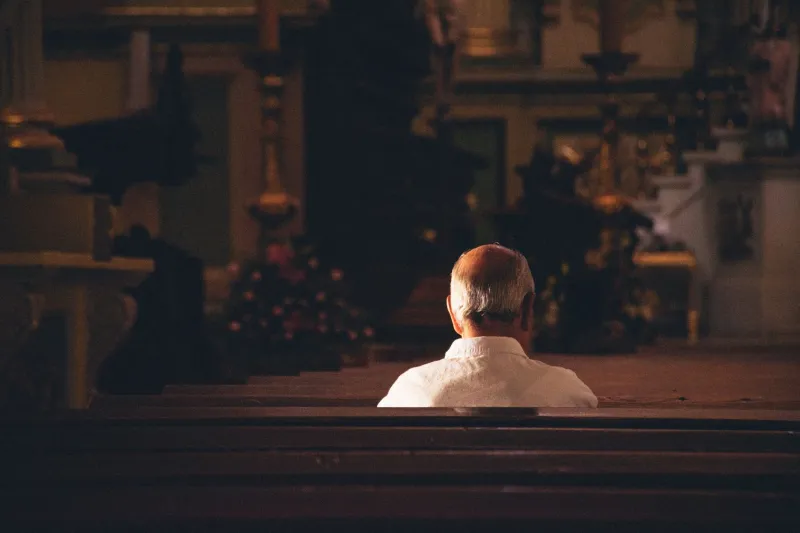
Hidden in Plain Sight: What Patna's Intimate Congregations Reveal About American Christianity's Fear of Being Truly Known

There is a peculiar loneliness that lives inside large American churches. It is not the loneliness of an empty room — the seats are full, the music is polished, the coffee is excellent. It is the loneliness of a crowd in which no one is required to know your name, your history, or the particular shape of your suffering. You may attend for years, shake hands at the door, and remain, in every meaningful spiritual sense, anonymous. And for many American believers, this arrangement is not a failure. It is, quietly, the point.
Patna's small Christian congregations — many of them gathered in modest chapels, school halls, or the courtyards of institutions with long memories — operate by an entirely different logic. In these communities, anonymity is not an option the architecture provides. When a congregation numbers in the dozens rather than the thousands, when families have worshipped together across three generations, when the parish priest has buried your grandmother and baptized your nephew, there is simply nowhere to hide. You are known. Fully, inconveniently, and without the relief of reinvention.
For Western Christians accustomed to the protective distance of the modern megachurch, this sounds either beautiful or terrifying. Often, it is both.
The Architecture of Avoidance
American church culture has, over the past several decades, built extraordinary infrastructure for belonging without vulnerability. Small group ministries, online campuses, multisite congregations, and digital community platforms all promise connection while carefully managing its depth. A believer can join a Facebook group for their church, attend a weekly service in a crowd of two thousand, participate in a curated small group for a season, and still never be known in the way that Scripture describes as the hallmark of genuine community.
This is not accidental. The large congregation model, whatever its genuine strengths in outreach and resource, offers a structural kindness to the emotionally guarded: you may belong on your own terms. You control the disclosure. You decide how much of yourself is on offer. The community receives the version of you that you have edited for public consumption, and the transaction is complete.
Patna's faith communities, shaped by decades of resource constraints and geographic particularity, never had the luxury of building such elaborate defenses. The result is something that looks, from the outside, like limitation. From the inside, it functions as a kind of grace.
What It Means to Be Seen
The theological tradition from which Christianity draws has always insisted that being known is not incidental to spiritual formation — it is constitutive of it. The Psalms are not anonymous documents. The epistles of Paul are addressed to specific people in specific places, navigating specific conflicts. The early church in Acts is described with striking particularity: they knew whose house they were in, who was sick, who had sold land, who had lied. The community was not an abstraction. It was a set of named, located, accountable people.
In Patna's parish communities, this particularity is not a theological achievement. It is simply the texture of daily life. The teacher at the mission school is also the lector at Sunday Mass. The woman who runs the charitable relief program is the same woman who noticed, three months ago, that a particular family had stopped attending and went to find out why. The connections are not managed through a church management software system. They are maintained through the slow, unglamorous work of sustained presence.
What this produces, over time, is a community in which spiritual struggle cannot easily be concealed behind a performative Sunday smile. When the people around you have known you long enough to notice the difference, pretending becomes exhausting. And exhaustion, as any honest spiritual director will tell you, is often the beginning of genuine formation.
The Digital Substitute and Its Limits
It would be unfair to dismiss the ways in which digital community has served isolated believers, particularly in seasons of illness, geographic dislocation, or social marginalization. Online faith spaces have been genuine lifelines for many. The concern is not with the technology itself but with the pattern of substitution — the quiet migration from embodied, local, accountable fellowship toward digital connection as a primary mode of belonging.
A screen cannot notice that you have lost weight. An algorithm cannot sit with you in a hospital waiting room. A comment section cannot hold you accountable to a promise you made before God and witnesses. These are not minor deficiencies. They are, in fact, the very capacities that make community spiritually formative rather than merely emotionally pleasant.
Patna's Christians, many of whom have limited access to the digital infrastructure that American believers take for granted, have not experienced this substitution. Their community remains stubbornly, inconveniently physical. It asks things of them that a podcast cannot ask. It gives them things that a livestream cannot give. The exchange is more demanding and, by every account that emerges from these communities, more nourishing.
The Spiritual Cost of Protective Distance
There is a cost to the arrangement American Christianity has made with anonymity, and it is worth naming directly. When we are not known, we cannot be truly prayed for — only prayed over in general terms. When we are not known, accountability becomes voluntary, and voluntary accountability tends, under pressure, to dissolve. When we are not known, the particular mercy we need cannot reach us, because no one knows precisely where we are.
More subtly, when we are not known, we are deprived of the experience of being loved anyway. The love that transforms is not the love extended to the curated, edited, publicly acceptable version of a person. It is the love extended to the actual person — the one with the difficult history, the recurring failure, the unflattering need. That love requires knowledge. And knowledge requires the willingness to be seen.
Patna's small faith communities are not perfect. They carry their own wounds, their own unresolved conflicts, their own histories of failure. But they do not, by and large, offer their members the option of spiritual tourism — of passing through without being changed, without being known, without being held to something larger than their own preferences. That refusal, however uncomfortable, is one of the most serious gifts a Christian community can offer.
An Invitation Worth Considering
For American believers reading this from the comfortable distance of a large congregation or a digital community, the invitation here is not necessarily to abandon those contexts. It is, rather, to examine honestly what protective distance has cost — and whether the safety purchased was worth the price.
The communities gathered around places like Jesus and Mary in Patna have long understood something that Western Christianity is only beginning to recover: that being known is not a vulnerability to be managed. It is a sacramental act. It is, in its own quiet way, the place where grace enters.
The question is not whether such intimacy is possible in the American church. It is whether enough of us want it badly enough to stop hiding.